📦 Energy Gel EDGE Watermelon + Caffeine back in stock | 🇦🇺 Free shipping in Australia over 220 AUD
$0.00
0
What Makes UCAN EDGE Different: The Slow Release energy Gel
A slow release energy gel is not a sugar gel with a different label on it. UCAN EDGE is built on a carbohydrate molecule roughly a thousand times larger than the sugars in a conventional gel, and that single difference changes how long one serve lasts and how your stomach handles it.
This is the mechanism, the numbers behind it, and how to time EDGE around your own sessions.
The short version
Molecular weight and osmolality are inversely related. LIVSTEADY sits at 500,000 to 700,000 g/mol against 100 to 500 g/mol for sugars and maltodextrin, so it exerts very little osmotic pressure in the gut and clears the stomach with almost no water behind it. One serve covers 75 minutes or more instead of twenty.
There are dozens of brands and a lot of flavours, but underneath them most gels share the same two limitations regardless of who makes them.
The energy arrives fast and leaves fast
Most gel formulas are built on simple sugars, some combination of glucose, fructose, sucrose and dextrose, with the explicit aim of getting energy into you quickly. That works, and for a short hard effort it is often all you need.
The problem is the shape of the curve rather than the peak. Energy that arrives in fifteen minutes is largely gone by forty, which is why standard race nutrition advice has you taking the next gel before the last one has finished working. You are topping up on a timer rather than riding a single serve, and by the fourth or fifth sachet the arithmetic gets hard to hold at pace.
Repeated use is hard on the stomach
A simple sugar formula is a solution of many individual molecules, which means it exerts high osmolality in the gastrointestinal tract. That osmotic force slows gastric emptying and drives the bloating and nausea a large proportion of endurance athletes report at some point. It is also why manufacturers tell you to chase a gel with water: the gut has to dilute it before it can absorb anything.
Maltodextrin was the industry's answer. It carries lower osmolality than simple sugars, but it is assimilated just as quickly, so it inherits most of the same behaviour.
Although theoretically drinking maltodextrin should allow for increased delivery of carbohydrate and water because of better gastric emptying, experimental results have proved disappointing.
Dr Jeff Volek, professor of kinesiology, The Ohio State University
What makes UCAN EDGE a slow release energy gel
EDGE is built on LIVSTEADY, a patented carbohydrate made from non-GMO corn starch. It is not a sugar and it is not a fibre. Chemically it is a complex carbohydrate that is fully absorbed as energy, just on a different timescale.
The whole difference comes down to one property.
Carbohydrate
Molecular weight
Osmotic pressure in the gut
Water needed to take it
Simple sugars
100 to 500 g/mol
High
Yes, and a decent amount
Maltodextrin
Short chain, low hundreds
Moderate
Usually
LIVSTEADY in EDGE
500,000 to 700,000 g/mol
Very low
No
Molecular weight and osmolality are inversely related. A very large molecule exerts very little osmotic pressure, so it empties from the stomach into the intestines quickly instead of sitting there pulling water in. That is the mechanism behind everything athletes notice about EDGE, and it is why the texture is thin liquid rather than thick syrup.
LIVSTEADY was originally developed as a medical food for children who could not reach the energy they had stored, and needed a carbohydrate that released slowly enough to carry them through the night. The full story is in our story.
How to fuel your sessions with EDGE
Whether you are lifting, running long, or riding, take one EDGE gel 30 to 45 minutes before you start. For anything over 90 minutes, take another every 45 to 60 minutes during the session.
Session
Before
During
Under 60 minutes
1 gel, 30 to 45 min out
Nothing needed
60 to 120 minutes
1 gel, 30 to 45 min out
1 gel around the hour mark
Long run or marathon
1 gel or 1 serve Energy Powder
1 gel every 60 min
Hard intervals or threshold
1 gel, 30 to 45 min out
1 gel every 45 min
Long ride or long course
1 serve Energy Powder
1 gel every 60 min, plus Hydrate
Two things worth knowing about the timing:
Take it slightly before you need it. Because the energy arrives gradually rather than in a rush, work out how long one serve lasts for you, then take the next one about fifteen minutes before that window closes. Fuel ahead of fatigue rather than chasing it.
You do not need water with it. The low osmolality means nothing has to be diluted before absorption. The consistency is closer to a thin liquid than a syrup, so it goes down at pace without a bottle.
Edge allows my runners to fuel with a simpler process. They don't have any GI distress, they have better energy later in their races, and after they finish running they're not so hungry that they're raiding the pantry cabinets.
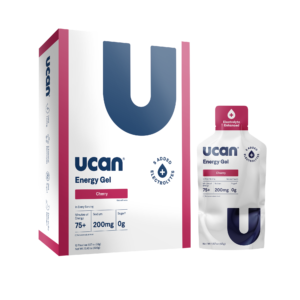
All three carry the same 19 g of carbohydrate and the same slow release behaviour. What changes is what sits alongside it.
EDGE. 55 mg sodium. The default for cool conditions and for anyone already running a separate electrolyte drink.
EDGE + Electrolyte. 200 mg sodium, plus potassium, chloride, magnesium and calcium. For humid days, heavy sweaters, and long course racing.
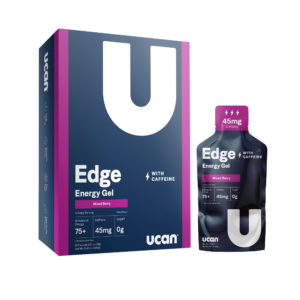
EDGE Mixed Berry with caffeine. 45 mg caffeine, a deliberately small dose that is easy to place in a race plan without pushing past your daily total. The caffeine guide works through the arithmetic.
Frequently asked questions
What is a slow release energy gel?
A gel built on a large, complex carbohydrate molecule rather than simple sugars, so the body takes longer to break it down and the energy arrives gradually. LIVSTEADY, the carbohydrate in UCAN EDGE, sits at 500,000 to 700,000 g/mol, which is why one serve covers 75 minutes or more instead of twenty.
Do I need water with a UCAN EDGE gel?
No. The low osmolality means there is nothing concentrated for your gut to dilute before it can absorb anything, so EDGE clears the stomach with very little water behind it. The texture is thin liquid rather than thick syrup. Stay hydrated through the session regardless.
Is LIVSTEADY a sugar or a fibre?
Neither. It is a complex carbohydrate made from non-GMO corn starch, fully absorbed as energy. EDGE carries zero sugar, and the fibre content is low, so it does not behave like a bulking agent.
How long does one EDGE gel last?
75 minutes or more from a single pouch. In practice most athletes take the next one every 45 to 60 minutes so they are fuelling ahead of the window closing rather than after it. Work out your own interval on a long run before you race it.
Can I use EDGE for short, hard sessions?
Yes, taken 30 to 45 minutes before. For a 5 km or a sprint finish where you want something to arrive quickly, a sugar gel is more responsive. The longer the effort, the more the slow release advantage compounds, and around 90 minutes is roughly where it starts to win clearly.
Is EDGE suitable for tested athletes?
EDGE is a formulated supplementary sports food with no banned substances in the formula. It does not carry Informed Sport or HASTA certification. If you compete under a testing programme, check the current batch with your federation before you race it.
This food is a formulated supplementary sports food and is not a sole source of nutrition. It should be used in conjunction with an appropriate physical training or exercise programme and consumed in conjunction with a nutritious diet. Not suitable for children under 15 years of age or pregnant women. Guidance here is general and not individual advice. Gut tolerance varies between individuals, so test any change to your fuelling in training before you race it.
Three ways to start
Same carbohydrate in all three. Pick on conditions, not on flavour.
Walk into any servo, supermarket or sports store in Australia and you will see two categories sitting next to each other: sports drinks and electrolyte...
Recovery Nutrition Tips for Runners Recovery nutrition for runners is key to replenishing and refueling to ensure that you have energy stores available to use...
FUELING YOUR PERSONAL BEST American Half Marathon Record Holder Emily Sisson relies on UCAN for long-lasting energy with no crash. SUSTAINED ENERGY WITHOUT GI DISTRESS...




 28Oct
28Oct  by
by 



Comments are closed