📦 Energy Gel EDGE Watermelon + Caffeine back in stock | 🇦🇺 Free shipping in Australia over 220 AUD
$0.00
0
Caffeine Before Running: How It Works, How Much, and When
By Generation UCAN Australia. Last updated October 2026.
Take caffeine 30 to 60 minutes before you run and the same pace feels easier. That is the short version of decades of research, and it is why the Australian Institute of Sport places caffeine among the few supplements with strong evidence behind them.3
This guide explains caffeine before running in practical terms: what it does in your body, how much to take for your weight, when to take it, and how to build it into a marathon without upsetting your stomach. It is written for runners and triathletes who train with numbers.
Enough for most athletes. Research goes up to 6 mg per kg, with more side effects and little extra gain.
30 to 60 minutes
Time for caffeine to reach peak levels after you take it.
Around 5 hours
Average half-life. A 4pm dose is still active at 9pm.
400 mg a day
The upper daily intake food regulators reference for healthy adults.
What caffeine does when you run
Caffeine works mainly on your brain. During exercise, a compound called adenosine builds up and signals fatigue. Caffeine blocks the receptors adenosine binds to, which turns that fatigue signal down.1
You feel this as lower perceived effort. The pace you hold at hour two feels closer to how it felt at hour one. Studies also show sharper focus and faster reaction time, useful on technical trail descents and in the final kilometres of a race when decisions get harder.1
Caffeine provides no energy of its own. It changes how hard the work feels, so you still need carbohydrate to fuel that work. Caffeine and fuel do two separate jobs, which is why runners use them together.
Does caffeine improve running performance?
For most people, yes. A 2018 meta-analysis of endurance studies found caffeine improved time-trial performance by around 2 to 3% on average, with some athletes responding more and a few not at all.2 UCAN's summary of the research puts the range at 2 to 4%.8
Apply that to a 4:30 marathon. A 2% gain is about 5 minutes, with no change to your training.
Caffeine also sits in Group A of the AIS Sports Supplement Framework, the category for supplements with strong scientific evidence for use in specific sport situations.3
Your response is personal. Genetics influence how fast you clear caffeine. Test it on long runs, note how you feel and how you finish, and only then use it on race day.
How much caffeine before running
Base your dose on body weight. The International Society of Sports Nutrition reports benefits from 3 to 6 mg per kg, with effects seen from as little as 2 mg per kg.1 The AIS notes that 1 to 3 mg per kg works for most athletes, and that higher doses bring more side effects without much more performance.3
Find your weight in the table to see what each dose looks like, and how many 45 mg caffeine gels reach a moderate dose across a long run or race.
Body weight
1 mg/kg
2 mg/kg
3 mg/kg
45 mg gels for 3 mg/kg
55 kg
55 mg
110 mg
165 mg
3 to 4
65 kg
65 mg
130 mg
195 mg
4
75 kg
75 mg
150 mg
225 mg
5
85 kg
85 mg
170 mg
255 mg
5 to 6
Spread gels across the session rather than taking them together, and count any coffee you drink before the start toward your total.
Coffee is the hard part to measure. A study of espresso-based coffees bought from cafés on the Gold Coast found caffeine ranged from 25 mg to 214 mg per serve.5 Your morning flat white could be a light dose or most of your target. A gel delivers the same dose every time.
When to take caffeine before running
Take caffeine 30 to 60 minutes before the effort you want it for. Levels peak in that window and stay elevated for hours, because caffeine has an average half-life of around 5 hours.1
Runs under 90 minutes
Take one dose 30 to 60 minutes before the start. A coffee or a single caffeine gel covers the whole session.
Long runs, marathons and long-course triathlon
Split the dose. Caffeine from the start line is still active later, but perceived effort climbs fastest in the second half, so a second dose around halfway and an optional third in the final third land where they help most. UCAN's rule of thumb for runners who respond well: one caffeine gel at the start and one around halfway.8
Evening sessions
Leave at least 6 hours between caffeine and bed. Caffeine before a 6pm interval session can cost you the sleep that lets you absorb the training.
A caffeine plan for marathon day
Use this worked example for a 75 kg runner targeting a 4 hour marathon. It follows UCAN's marathon protocol of one Edge gel every 45 to 60 minutes, with caffeinated gels placed where caffeine helps most.7
That total works out at 1.2 to 3.1 mg per kg depending on the options you take, in line with the AIS range at the low end and the ISSN starting point at the top. Rehearse the full plan on at least two long runs first.
Coffee or a caffeine gel?
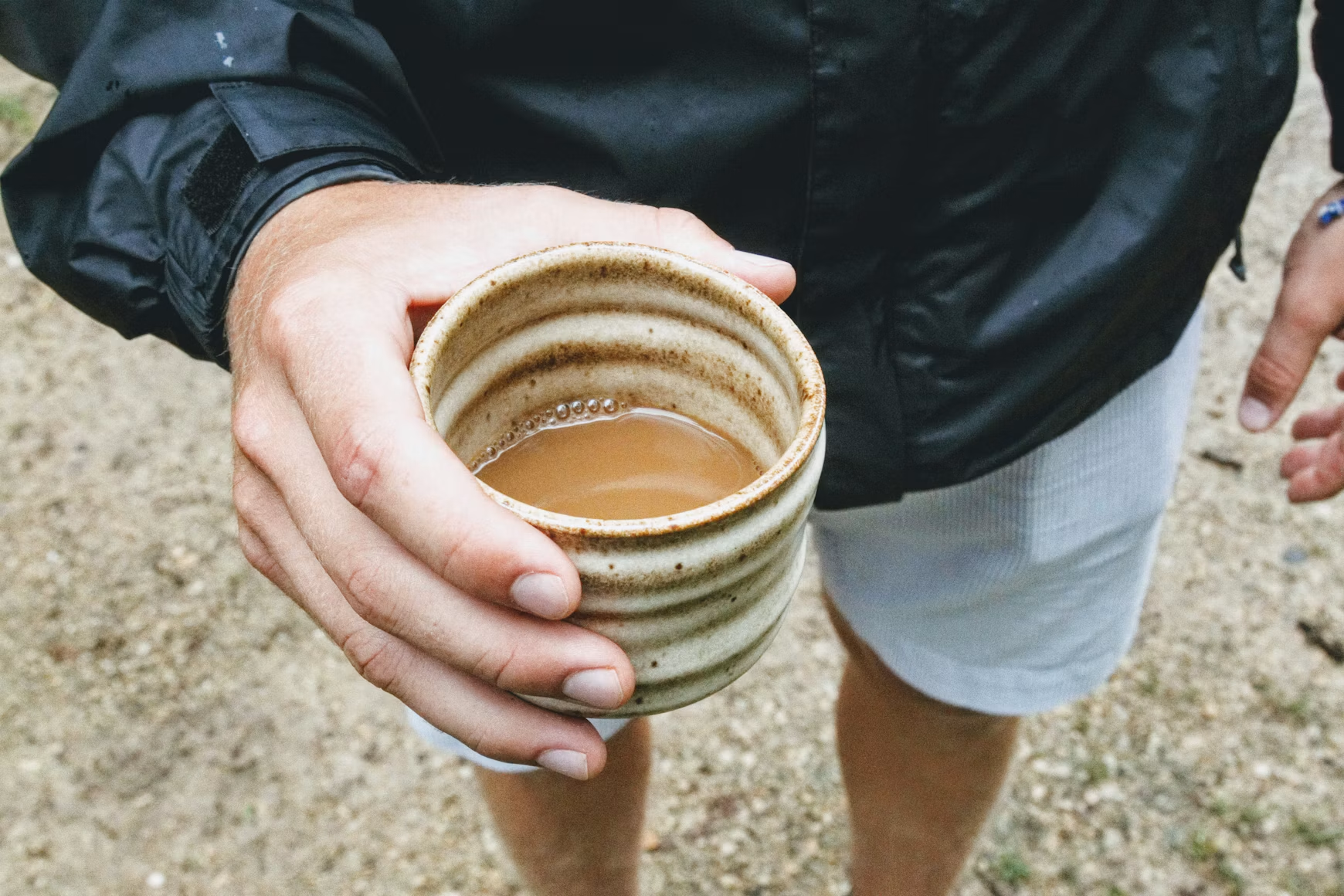
Use each where it fits. Coffee works before the start if it is already part of your routine and your stomach handles it. Once you are running, it is hard to carry and hard to dose.
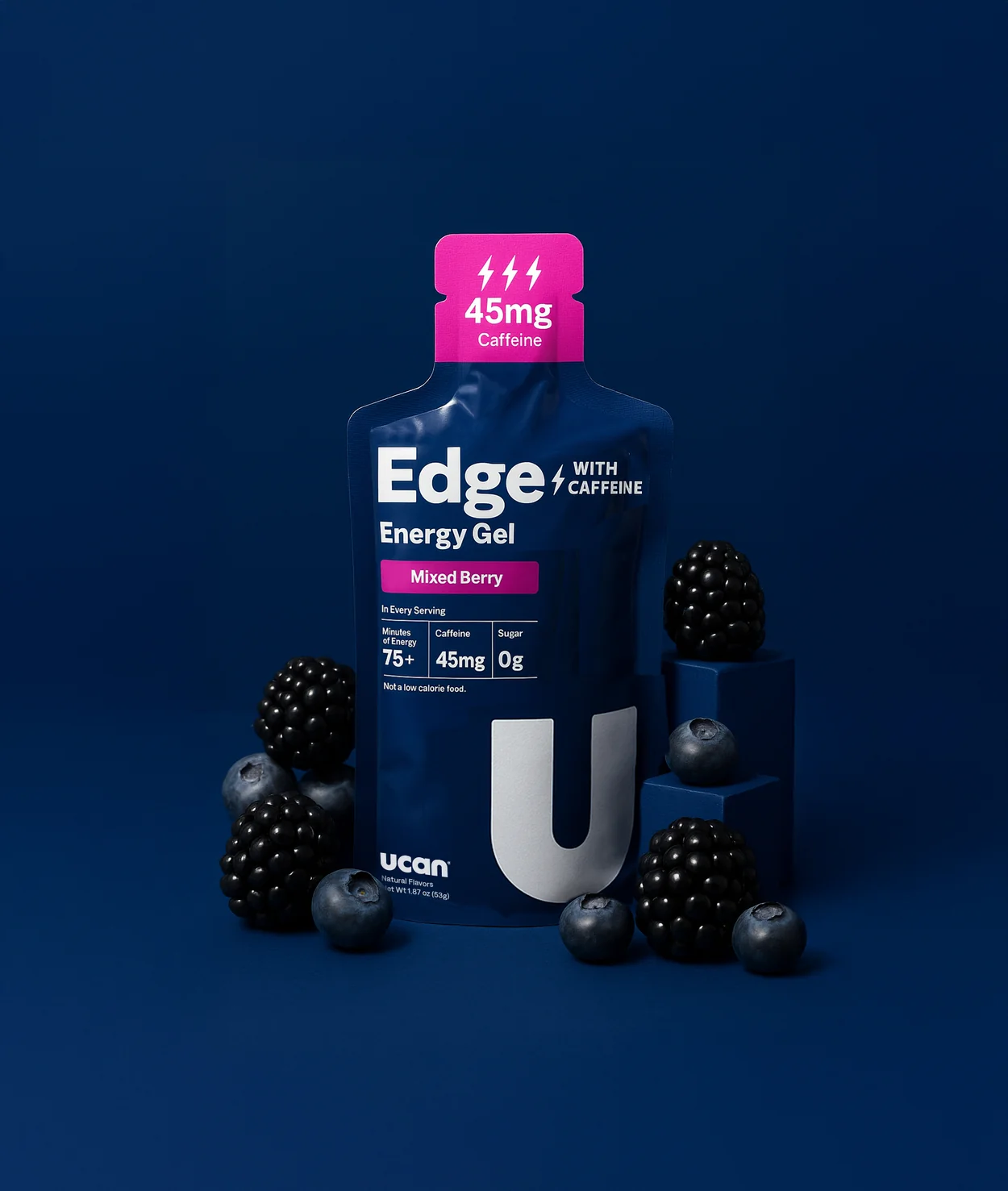
A caffeine gel gives you a measured dose and carbohydrate in one pouch, which suits the middle and back half of a race. UCAN Edge + Caffeine pairs 45 mg of caffeine with LIVSTEADY™, a slow-release carbohydrate, and contains 0g sugar. The gel fuels the effort while the caffeine changes how that effort feels.
How to start using caffeine in training
Take one 45 mg gel around the halfway point of a long run. Note your stomach, your heart rate and how the last third felt.
If it sits well, add a second caffeinated gel on your next long run.
Rehearse your full race-day plan on at least two long runs, including breakfast coffee if you plan to have it.
Keep your daily coffee. Research shows habitual coffee drinkers still respond to caffeine before exercise, so there is no need to cut it out before a race.4
Side effects and who should skip caffeine
Most athletes tolerate the doses above well. Watch for these signs that you have taken too much, or taken it too late:
Poor sleep. The 5 hour half-life carries late doses into the night.
Stomach upset. Large doses can mean more toilet stops, especially on top of race nerves.
Higher heart rate. Some athletes notice this on hard efforts or at 30 degrees and above.
Jitters. Sensitive runners feel this at low doses. Stick to one gel or go caffeine free.
Caffeinated sports foods are not recommended for children, or for anyone pregnant or breastfeeding. If you have a heart condition or take regular medication, check with your doctor first.
Prefer to skip caffeine? Every other Edge flavour is caffeine free and uses the same LIVSTEADY™ carbohydrate. See the caffeine free Edge range.
UCAN Edge + Caffeine in Australia
Pick your flavour. Two caffeinated Edge flavours are available in Australia now, each with 45 mg of caffeine per gel, in boxes of 12.
Mixed Berry Edge + Caffeine
45 mg caffeine0g sugar
Tart berry flavour. A good first caffeine gel, and an easy pick for your start-line dose.
Salted Caramel, Vanilla Latte and Watermelon Edge + Caffeine return to the Australian range in 2027.
Caffeine before running: common questions
How much caffeine should I take before running?
Most athletes benefit from 1 to 3 mg per kg of body weight, which is 75 to 225 mg for a 75 kg runner. Research ranges go up to 6 mg per kg, but side effects rise faster than performance above 3 mg per kg. Start low and test in training.
How long before a run should I take caffeine?
Take it 30 to 60 minutes before the effort. Caffeine peaks in that window and stays active for several hours, so for long races a second dose around halfway targets the hours when fatigue builds.
Does caffeine still work if I drink coffee every day?
Yes. Research shows habitual coffee drinkers still respond to caffeine before exercise. You do not need to cut coffee out in race week.
Can I take caffeine gels during a marathon?
Yes. A common approach is one caffeine gel before the start and one around halfway, with an optional third around 32 km. Swap them in for caffeine free gels inside your normal fuelling schedule rather than adding extra gels.
Does caffeine dehydrate you when you run?
At the doses used in sport, research suggests caffeine does not meaningfully affect hydration. Keep drinking to your sweat rate and add electrolytes on hot or long days.
Is a caffeine gel better than coffee before a run?
They suit different moments. Coffee works well before the start if it is part of your routine. A caffeine gel gives a measured dose plus carbohydrate, which makes it easier to use during a race.
Who should avoid caffeine before exercise?
Caffeinated sports foods are not recommended for children, or for anyone pregnant or breastfeeding. Anyone with a heart condition or on regular medication should check with their doctor first.
References
Guest, N. S., et al. (2021). International Society of Sports Nutrition position stand: caffeine and exercise performance. Journal of the International Society of Sports Nutrition, 18(1), 1.
Southward, K., Rutherfurd-Markwick, K. J., & Ali, A. (2018). The effect of acute caffeine ingestion on endurance performance: a systematic review and meta-analysis. Sports Medicine, 48(8), 1913–1928.
Australian Institute of Sport. AIS Sports Supplement Framework: Caffeine (Group A).
Gonçalves, L. S., et al. (2017). Dispelling the myth that habitual caffeine consumption influences the performance response to acute caffeine supplementation. Journal of Applied Physiology, 123(1), 213–220.
Desbrow, B., et al. (2007). An examination of consumer exposure to caffeine from retail coffee outlets. Food and Chemical Toxicology, 45(9), 1588–1592.
EFSA Panel on Dietetic Products, Nutrition and Allergies (2015). Scientific opinion on the safety of caffeine. EFSA Journal, 13(5), 4102.
The UCAN Company. Marathon nutrition tips. ucan.co
The UCAN Company. Caffeine and athletic performance: what athletes should know about caffeine and exercise. Energy Lab blog, ucan.co.
Sports Dietitian Bob Seebohar was the personal sports dietitian for the 2008 U.S. Olympic Triathlon team and takes a cutting-edge approach to nutrition with his Metabolic Efficiency
The combination of white, pink blast, total orange and bright crimson will mark Nike's presence in Tokyo across select performance and lifestyle products.
We’re all familiar with the afternoon slump. You’re going about your day, feeling fine, but then 2 p.m. hits—and instead of thinking about a pre-dinner workout, you’re suddenly thinking about a pre-dinner nap.
Best Caffeine Gel for Endurance: How Caffeine Fuels Performance For most endurance athletes, caffeine is part of the ritual. A coffee before a morning run,...
by Sarah UCAN AUS Team1391Comments Off on Best Caffeine Gel for Endurance: How Caffeine Fuels Performance


 by Sarah UCAN AUS Team
113
Comments Off on How Sara Hall Takes Her Training to the Next Level with UCAN
by Sarah UCAN AUS Team
113
Comments Off on How Sara Hall Takes Her Training to the Next Level with UCAN 

Comments are closed