📦 Energy Gel EDGE Watermelon + Caffeine back in stock | 🇦🇺 Free shipping in Australia over 220 AUD
$0.00
0
How Sara Hall Takes Her Training to the Next Level with UCAN
Masters marathon nutrition is usually written as a list of things you are supposed to give up. Sara Hall makes the opposite case. She set the American women's masters marathon record in Valencia in December 2024, running 2:23:45 in her forties, and she has been running the fastest times of her career well past the age most people are told to expect a decline.
Her explanation is not complicated, and it is not about training harder. It is about recovering well enough to train hard again two days later.
The short version
Past forty the limiter stops being how much you can train and becomes how quickly you can absorb it. That shifts the priority from what you take during a session to what you take in the hour after it, and to keeping added sugar low across the rest of the week so the body is not dealing with more than it needs to.
Worth setting out, because the record matters less than the length of the career behind it.
American women's masters marathon record holder, 2:23:45, Valencia, December 2024
Former American record holder in the half marathon
Runner up at the 2020 London Marathon
2017 US Marathon Champion, 2018 Ottawa Marathon Champion
Three time US 10 Mile Champion and 20k National Champion
Human biology major, which is a large part of why she pays attention to this at all
She is also the mother of four daughters adopted from Ethiopia, and married to Ryan Hall. The point of listing it is that she has been racing at a high level for two decades while running a household, which is closer to most readers' lives than the training camp version of elite sport.
What actually changes after forty
Not the training. Almost every masters runner can still do the sessions. What changes is the cost of doing them.
A hard interval session at 30 leaves you sore on Tuesday and ready on Wednesday. The same session at 45 leaves you sore on Tuesday, flat on Wednesday, and cautious on Thursday. Over a sixteen week build that is not one lost session, it is a quarter of the quality work in the block.
So the lever moves. At 30 you get faster by adding volume. At 45 you get faster by shortening the gap between the session and being ready for the next one.
Recovery has been a big focus of my career.
Sara Hall, quoted on ucan.co
That is the whole strategy in one line. Everything below is the execution.
How Sara Hall fuels a session
The routine is simple enough to copy, which is the useful part.
When
What
Why it is there
Before the session
A serve of slow release carbohydrate
Starts the session with fuel already working rather than drawing on stores from the first kilometre
Between warm up and the work
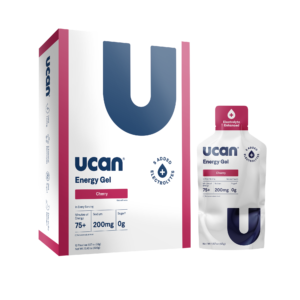
An EDGE gel
Portable, and it goes down in the few minutes between finishing strides and starting the first rep
During long efforts
Slow release carbohydrate at intervals
Fewer sachets to manage, and a level supply through the back half
Immediately after
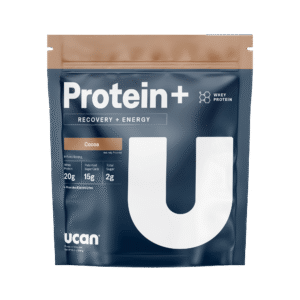
Two scoops of Cocoa Energy + Protein
The single most important item on this list for a masters athlete. Carbohydrate and protein together, straight away
A few hours later
A real meal
The shake is not the meal. It buys the time until the meal arrives
Before bed
A protein serve
Seven to nine hours is the longest gap in your day. She does not leave it empty after a hard session
Edge sits really well in my stomach.
Sara Hall, quoted on ucan.co
Unremarkable as a quote, and that is the point. At a certain level the fuel you can stop thinking about is the fuel that works.
Why she keeps added sugar low
Hard training is inflammatory. That is not a problem, it is the mechanism, and the adaptation comes from repairing it. But an athlete in a heavy block is already carrying a load, and the argument Sara makes is that there is no reason to add to it from the rest of the diet.
So her training fuel carries no added sugar, and her daily eating keeps it low as well. It is a decision about total load rather than about any single food.
I've been able to finish my races stronger than ever.
Sara Hall on switching from maltodextrin, quoted on LetsRun
She said that after the 2020 London Marathon, where she came second on a strong second half. The mechanism behind it, and why a larger carbohydrate molecule behaves differently in the gut, is set out in what is LIVSTEADY.
What to take from it if you are not a professional
You do not have her weekly volume, and you do not need her weekly volume to benefit from the same order of priorities.
Fix the hour after first. Not the gels, not the pre workout, not the supplement you read about. Carbohydrate and protein within the hour of finishing, every hard session. It is the change with the largest effect and the lowest effort.
Make it one action. The reason most people skip recovery nutrition is logistics, not knowledge. A pouch in the bag beats a plan you execute two hours later at home.
Do not leave the night empty after a hard day. A protein serve before bed on the nights that follow your heaviest sessions, not every night.
Keep the fuel decision separate from the sugar decision. You still need carbohydrate for long sessions. What you do not need is unplanned sugar arriving from four different products at once.
Rehearse it. A routine you have run twelve times is one you will still follow when you are tired, which is exactly when it matters.
What changes about marathon nutrition after forty?
The priority moves from the session to the hours after it. Most masters runners can still complete the training. What limits them is how long it takes to be ready for the next hard day, so carbohydrate and protein within the hour of finishing does more for the block than anything you take during it.
What does Sara Hall take after a hard session?
Two scoops of Cocoa UCAN Energy + Protein immediately after finishing, then a full meal a few hours later. The shake is not a replacement for the meal, it buys the time until the meal arrives.
Should masters runners train less?
Not necessarily less, but with more attention to what happens between sessions. Sara Hall is running the fastest times of her career in her forties on a full training load. What she has built around it is a recovery routine she does not skip.
Does a protein shake before bed actually help?
Seven to nine hours is the longest gap in your day. On the nights following a hard session, a protein serve before bed gives the repair process something to work with rather than leaving that window empty. On easy days, normal meals cover it.
Why does she avoid added sugar in her training fuel?
Hard training already places a load on the body, and the adaptation comes from recovering from it. Her argument is that there is no reason to add to that load from the rest of the diet. Her training fuel carries no added sugar and her daily eating keeps it low.
Can I buy the products Sara Hall uses in Australia?
Yes. Generation UCAN Australia is the official Australian reseller. Energy + Protein, EDGE gels and Energy Powder all ship from our warehouse in Dandenong South, Victoria, with free shipping on orders over $220. No six week wait from the United States.
Facts and quotes sourced from ucan.co and UCAN press material, correct as at August 2026. Quotes reproduced as published, including US spelling. This food is a formulated supplementary sports food and is not a sole source of nutrition. It should be used in conjunction with an appropriate physical training or exercise programme and consumed in conjunction with a nutritious diet. Not suitable for children under 15 years of age or pregnant women. Guidance here is general and not individual advice.
What the routine needs
Three products, and where each one sits in the day.
Sports Dietitian Bob Seebohar was the personal sports dietitian for the 2008 U.S. Olympic Triathlon team and takes a cutting-edge approach to nutrition with his Metabolic Efficiency
The combination of white, pink blast, total orange and bright crimson will mark Nike's presence in Tokyo across select performance and lifestyle products.
We’re all familiar with the afternoon slump. You’re going about your day, feeling fine, but then 2 p.m. hits—and instead of thinking about a pre-dinner workout, you’re suddenly thinking about a pre-dinner nap.
Best Caffeine Gel for Endurance: How Caffeine Fuels Performance For most endurance athletes, caffeine is part of the ritual. A coffee before a morning run,...
by Sarah UCAN AUS Team1428Comments Off on Best Caffeine Gel for Endurance: How Caffeine Fuels Performance
There are four completely different kinds of product sitting under the words electrolyte drink, and they are not interchangeable. The best electrolyte drink in Australia...




 14Aug
14Aug  by
by 


Comments are closed