📦 Energy Gel EDGE Watermelon + Caffeine back in stock | 🇦🇺 Free shipping in Australia over 220 AUD
$0.00
0
Best Electrolyte Drink in Australia: How to Choose
There are four completely different kinds of product sitting under the words electrolyte drink, and they are not interchangeable. The best electrolyte drink in Australia is the one that matches your training, and buying the wrong one means drinking sugar you did not plan for, or salt you do not need.
This guide sorts them out. What you actually lose in sweat, how to read a label properly, what separates the four product types on an Australian shelf, and where each one is genuinely the right answer. Including the cases where UCAN is not.
The short version
Decide first whether you want your drink to carry carbohydrate. That single question splits the market in half and answers most of the rest. Then check sodium per litre rather than per serve, because serve sizes are not comparable between brands. Then check whether magnesium and calcium are in there at all, because plenty of products skip them.
Sweat is not water. Five minerals leave with it, in roughly this order of quantity.
Mineral
Roughly how much you lose per litre of sweat
Why it is on the label
Sodium
400 to 1,800 mg, varies enormously between people
By far the largest loss, and the one every product leads with
Chloride
Tracks sodium closely
The other half of common salt. Often not declared separately, which is a clue about the formula
Potassium
150 to 250 mg
Contributes to normal muscle function. Losses are far smaller than sodium, so the doses are smaller too
Magnesium
Small, but it adds up across a long training week
Contributes to normal muscle and nerve function. The mineral most often left out entirely
Calcium
Small
The second mineral most products skip
Two numbers vary so much between individuals that no product can be right for everyone out of the box. Sweat rate in trained athletes commonly runs 0.8 to 1.5 litres per hour, and climbs past two litres in high humidity. Sweat sodium concentration ranges roughly four-fold. That is why the useful skill is reading a label, not picking a brand.
The four types of electrolyte product, and who each one suits
Every product on an Australian shelf falls into one of these four. Work out which category you need before you compare brands inside it.
Type
Typical sodium per litre
Carbohydrate
Best for
Wrong for
Traditional sports drinks Gatorade, Powerade
400 to 460 mg
50 to 60 g of sugar per litre
Anyone who wants fluid and fuel from the same bottle and is not counting either
Anyone already taking gels, because the carbohydrate stacks up unplanned
Salt forward mixes LMNT, Sodii
1,000 to 2,000 mg
Usually none
Very salty sweaters, ultra distance in heat, anyone who has done a sweat test and knows they lose a lot of salt
Drinking across three hours. Most people find that concentration hard to keep taking
Rehydration products Hydralyte
Varies, formulated as an oral rehydration solution
Contains sugar by design, which is how the formulation works
Illness and fluid loss outside sport, which is what they are made for
Training. They are not built as a session drink
Zero carbohydrate powders UCAN Hydrate, Nuun
600 to 660 mg for UCAN Hydrate
None
Athletes whose carbohydrate already comes from gels or powder, daily hydration, hot weather, rest days
Anyone expecting the bottle to also fuel them. It will not
The honest read on that table: if you have done a sweat test and know you are a heavy salt loser, a salt forward mix does that job better than anything else and you should buy one. If your carbohydrate is already sorted and you want minerals without touching your fuelling maths, a zero carbohydrate powder is the category. If you have not planned your fuel at all, a traditional sports drink is doing two jobs adequately and one of them badly.
How to read an electrolyte label in thirty seconds
Five checks, in this order. Most product pages will only volunteer the first one.
Convert sodium to per litre. Brands use serve sizes from 3 g to 10 g, mixed into anything from 300 ml to a litre. Comparing per serve is meaningless. Do the arithmetic once and write it on the tin.
Check whether magnesium and calcium are there at all. Plenty of products are sodium and potassium only. That is a cheaper formula, and it is a legitimate choice, but you should know you are buying it.
Check the carbohydrate line, not the sugar line. Zero sugar and zero carbohydrate are different claims. A product can be sugar free and still carry maltodextrin, which is carbohydrate you have to count.
Look at the sweetener. Stevia, monk fruit, sucralose and acesulfame potassium all taste different at hour three of a long run. This is the single most common reason people abandon a tub they paid for.
Count the ingredients. A five to eight ingredient electrolyte powder is doing one job. A twenty ingredient one has usually added things that are easier to put on a label than to justify.
How much sodium your electrolyte drink actually needs to carry
The internet argues about 1,000 mg an hour. Most published guidance for endurance events lands lower, between 300 and 600 mg of sodium per hour, with the top of that range for heavy or salty sweaters in heat.
The number that matters is your own, and you can measure it over one long run with a set of bathroom scales. The protocol and a calculator are in how much sodium you need per hour, and how to add up the sodium already sitting in your gels is in the guide to hydration for marathon training. Do that before you spend money on any of these products.
Where UCAN Hydrate sits
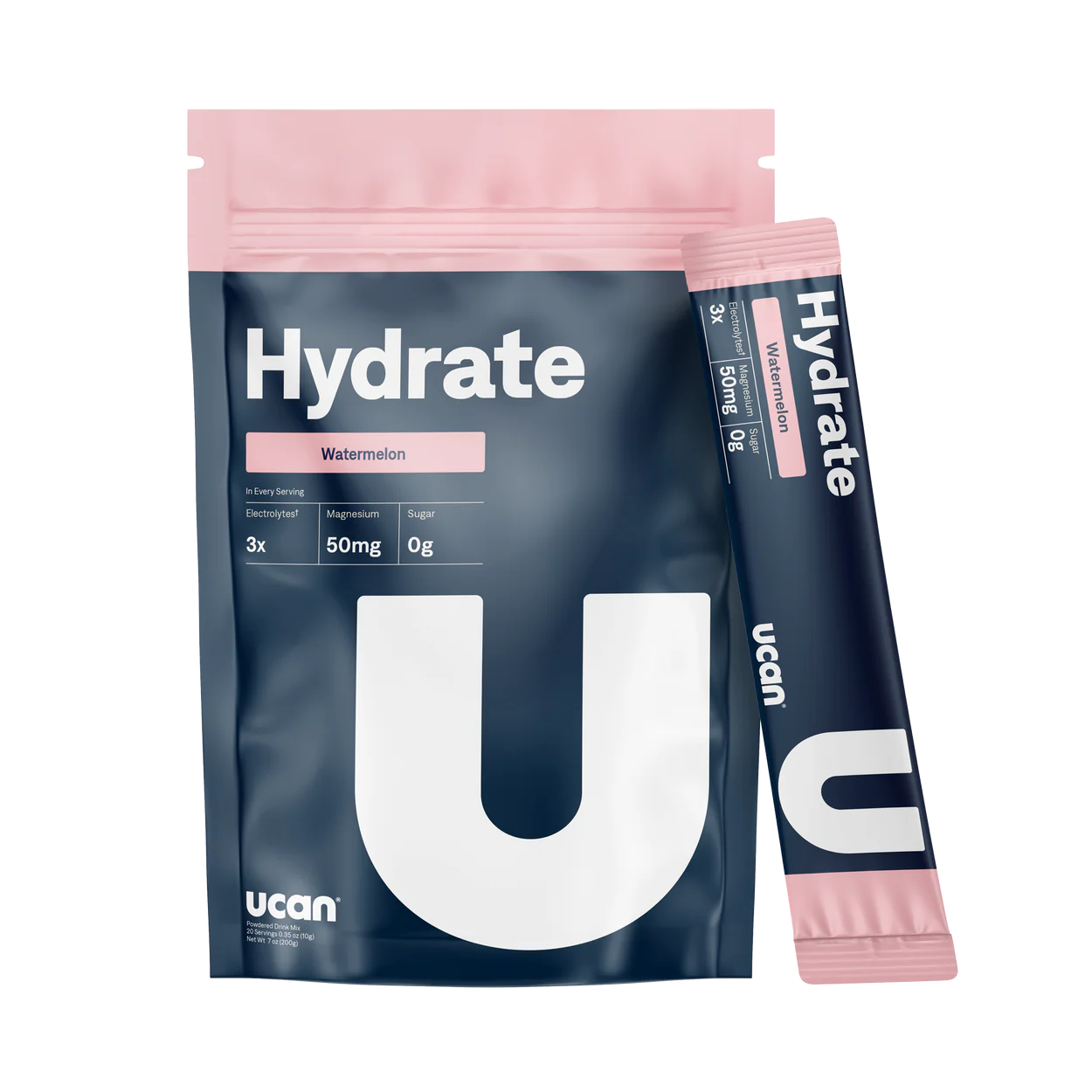
Zero carbohydrate powder category. Formulated by an Olympic dietitian, sweetened with stevia leaf extract, eight ingredients. Here is the full specification, read from the current pack labels.
Per 3 g serve in 500 ml
Amount
Per litre
Sodium
300 to 330 mg by flavour
600 to 660 mg
Chloride
150 mg
300 mg
Potassium
100 mg
200 mg
Magnesium
50 mg
100 mg
Calcium
20 mg
40 mg
Carbohydrate
0 g
0 g
Energy
0 calories
0 calories
Sodium is the only thing that changes between the four flavours. Lemon Lime 300 mg, Watermelon and Berry 310 mg, Pineapple 330 mg. Everything else is identical, and the jar and the sticks carry exactly the same 3 g serve, so choose the flavour on taste and the format on where you drink it.
Where it wins
Twice the magnesium of most electrolyte powders, and calcium, which sports drinks leave out entirely
Higher sodium per litre than a standard sports drink, with no sugar and no kilojoules
Zero carbohydrate, so adding it changes nothing in your fuelling plan
Stevia only, with no artificial sweeteners
Light enough to keep drinking across a three hour session
Where it loses
Salt forward mixes carry two to three times the sodium. If you specifically want salt loading, buy one of those
A supermarket sports drink is a fraction of the price and available everywhere
It carries no carbohydrate, so it does nothing for your fuel
Four flavours, where some competitors run a dozen
What people say after using it
Reviews from verified UCAN purchasers, reproduced as written.
"This is a fantastic product! I feel like it's been missing from my training bag forever! Love the flavor and the ease to mix."
Thomas H. · verified buyer on ucan.co
"We love the car packs for how easy they are to have with us traveling, hiking etc. They mix easily and taste great, unlike others we've tried."
Tim F. · verified buyer on ucan.co
Ratings and customer quotes sourced from ucan.co, UCAN USA, correct as at August 2026. 4.74 out of 5 from 271 reviews across the UCAN Hydrate range. Reviews are from verified US purchasers and are shown here for reference. They are not reviews of Generation UCAN Australia. Quotes are reproduced as written, including US spelling.
Choosing an electrolyte drink for Australian conditions
Most published hydration advice was written for cool weather racing. Australians train and race across a much wider temperature range than that, and the numbers move with the conditions rather than with the calendar.
Conditions
What to change
Hot and dry Adelaide, Perth
Sweat evaporates fast, so you feel less wet and drink less than you should. Set a schedule instead of drinking to thirst.
Hot and humid Darwin, Brisbane, Cairns
Sweat drips rather than evaporating, so you lose fluid with no cooling benefit. This is where the highest hourly targets apply.
Variable Melbourne, Hobart
Two numbers rather than one. Run the sweat test twice, once cool and once warm, and use whichever matches the day.
Altitude Snowy Mountains, Blue Mountains
Faster breathing means more fluid lost through respiration, and cool air hides it. Keep drinking on schedule even when you do not feel hot.
5 am starts, any city
An early start does not remove the need. Humidity is often highest just after dawn.
One practical detail worth more than any of the above: freeze half your bottle overnight and top it with water in the morning. People drink noticeably more when it stays cold.
When to drink it
When
What to do
20 to 30 minutes before
One serve in 500 ml of cold water. Matters most before early starts and hot afternoon sessions.
Sessions under 60 minutes
In cool conditions, water is enough. In heat, one serve is worth having.
60 to 120 minutes
One serve every hour to hour and a half, adjusted to your sweat rate and the day.
Past two hours
Keep the same rhythm rather than increasing volume late. Small amounts often beats large amounts occasionally.
After
Around 1.2 to 1.5 litres for every kilogram lost, spread across four to six hours rather than drunk in one go.
Rest days in heat
One serve a day is reasonable. There is no carbohydrate in it, so it costs you nothing nutritionally.
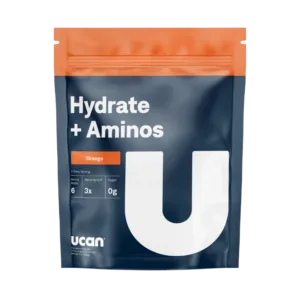
If you are drinking for more than 90 minutes at a time or backing up long sessions on consecutive days, there is a version with six amino acids added, covered in the guide to amino acids for endurance athletes. For everything shorter, standard Hydrate is the simpler and cheaper choice.
The rest of the plan
Electrolytes are one of three decisions, and the easiest one. The other two are how much carbohydrate you take per hour, and in what format. Both are covered on the marathon, triathlon and running pages. If you are weighing a sports drink against an electrolyte drink for running, sports drinks for running works through the carbohydrate arithmetic.
Where they intersect is worth knowing. UCAN Edge gels carry 50 mg of sodium each, and the Edge + Electrolyte version carries 200 mg, which counts toward your hourly total. Three of the four Energy Powder flavours carry 130 to 170 mg. Add them all up before you decide what goes in the bottle. The carbohydrate in all of them is LIVSTEADY, and the comparison against sugar based fuel is set out in sugar based vs sugar free energy gels.
Try it before you buy a tub
The mistake worth avoiding is spending $54.90 on 30 serves of a flavour you cannot drink at hour three. Watermelon and Pineapple are both available as a single sachet for $3.35. Test one on a real long run before you commit.
How do I choose the best electrolyte drink in Australia?
Decide first whether you want carbohydrate in the bottle, because that splits the market in half. Then convert sodium to a per litre figure so you can compare brands with different serve sizes. Then check whether magnesium and calcium are in the formula at all, and finally check the sweetener, because that is what determines whether you can still drink it at hour three.
What are the best electrolytes in Australia?
It depends on the job you need them to do. For training where your carbohydrate already comes from gels or a powder, look at zero carbohydrate electrolyte powders that declare all five minerals. If you have done a sweat test and know you lose a lot of salt, a salt forward mix at 1,000mg of sodium per litre or more does that job better. For illness rather than sport, an oral rehydration solution is the right category. Compare products within the category you need, on sodium per litre rather than per serve.
What is the best hydration drink?
For a session under an hour in mild conditions, water. Past an hour, or in heat and humidity, you need sodium as well as fluid, and the real choice is whether the same bottle should also carry carbohydrate. A sports drink does both jobs at once. A zero carbohydrate electrolyte drink does the hydration job only, which suits athletes who fuel separately with gels or powder.
How much electrolyte drink should I have in a day?
One to three serves is a reasonable range depending on how much you train, how hot it is and how much you sweat. In hot conditions, one serve a day on rest days is normal for people training regularly. Because it carries no carbohydrate and no kilojoules, it does not affect anything else you are eating.
Is a sugar free electrolyte drink better than a sports drink?
Better is the wrong frame. They do different jobs. A sports drink is trying to be your fluid and your fuel at once, which works if you have no other fuelling plan. If your carbohydrate is already coming from gels or powder, a sports drink adds carbohydrate you did not plan for and cannot easily measure. That is when a zero carbohydrate option is the right call.
Should I be using a high sodium electrolyte mix instead?
If you have done a sweat test and know you lose a lot of salt, yes, and salt forward mixes are built for exactly that. They carry two to three times the sodium of UCAN Hydrate. The trade is drinkability across a long session, which is why some athletes carry a high sodium mix for the first hour and something lighter after that.
How does an electrolyte powder compare to coconut water?
Coconut water carries useful potassium but very little sodium, which is the mineral you lose most of. It also carries natural sugars. It is a pleasant drink and it is not a training electrolyte solution, which is a different thing.
Can I mix it with other supplements?
Yes. An eight ingredient electrolyte powder with no carbohydrate mixes with protein powders, amino acids and most other performance products without complicating anything. The reason it is easy to combine is precisely that it carries nothing but minerals and flavour.
Which UCAN Hydrate flavour should I start with?
All four are the same formula except for sodium, which runs from 300 mg on Lemon Lime to 330 mg on Pineapple. So the decision is taste, not formulation. Pineapple is the one to reach for on the hottest days. Buy a $3.35 sachet of Watermelon or Pineapple before you buy a $54.90 jar.
Jar or sticks?
Identical formula and the same 3 g serve. The jar is around a third of the price per serve and lives at home. The sticks travel, fit a race belt and dose accurately without a scoop. Most people training seriously end up with both.
Nutrition figures read from current Australian pack labels. Competitor figures from published nutrition panels and dosing guidance, correct as at August 2026. Guidance here is general and not individual advice. Sweat rate and sweat sodium concentration vary widely between individuals and change with heat, humidity and fitness. Adjust from here based on your own testing.
Sports Dietitian Bob Seebohar was the personal sports dietitian for the 2008 U.S. Olympic Triathlon team and takes a cutting-edge approach to nutrition with his Metabolic Efficiency
The combination of white, pink blast, total orange and bright crimson will mark Nike's presence in Tokyo across select performance and lifestyle products.
We’re all familiar with the afternoon slump. You’re going about your day, feeling fine, but then 2 p.m. hits—and instead of thinking about a pre-dinner workout, you’re suddenly thinking about a pre-dinner nap.




 by Sarah UCAN AUS Team
122
Comments Off on How Sara Hall Takes Her Training to the Next Level with UCAN
by Sarah UCAN AUS Team
122
Comments Off on How Sara Hall Takes Her Training to the Next Level with UCAN 

Comments are closed