📦 Energy Gel EDGE Watermelon + Caffeine back in stock | 🇦🇺 Free shipping in Australia over 220 AUD
$0.00
0
How Much Sodium Do You Need Per Hour?
How much sodium per hour you need is one of the most argued about numbers in endurance sport, and most of the argument happens between people quoting figures that were never meant to apply to everyone. Social media has settled on 1,000mg an hour. Published guidance has not.
The range that shows up across sports nutrition literature is 300 to 600mg of sodium per hour for endurance work, alongside 400 to 550ml of fluid. Above that band you are into territory meant for genuinely heavy, salty sweaters rather than for everyone with a long run in the diary.
This guide covers where those numbers come from, how to work out your own sweat rate in a single session, and how to convert the answer into what actually goes in your bottle.
The short version
Start at 300 to 600mg of sodium and 400 to 550ml of fluid per hour for any session past 55 minutes. Take the lower end if you finish sessions barely damp, the upper end if you finish drenched with salt marks on your kit. Sip every 10 minutes rather than drinking large volumes at once. Then adjust across a few weeks based on how you feel, not on a number you read somewhere.
For endurance sessions running past 55 minutes, published guidance sits at 300 to 600mg of sodium per hour, paired with 400 to 550ml of fluid. Take the lower end if you are a light sweater in cool conditions, the upper end if you sweat heavily or train in heat and humidity.
That band is narrower than the internet suggests, and it is deliberately a starting point rather than a prescription. Above 600mg an hour you are in the range meant for athletes with genuinely high sweat rates and salty sweat, which is a real group but a much smaller one than the marketing implies.
Light sweater
300mg
Cool conditions, shirt still dry at the end
Moderate
450mg
Damp kit, occasional salt marks
Heavy sweater
600mg
Drenched, white streaks on your kit
Why there is no single number
Two athletes doing the same session in the same weather can lose very different amounts of sodium, and it comes down to two independent variables that most people conflate.
Variable
What it is
Typical spread
Sweat rate
How much fluid you lose per hour
Roughly 0.5 to 2.5 litres an hour, depending on effort, heat and humidity
Sweat concentration
How much sodium is in each litre of that sweat
Roughly 200 to 2,000mg per litre, and largely genetic
Multiply the two and the possible range of hourly sodium loss is enormous. That is why a fixed number on a packet cannot be right for everyone, and why the sensible approach is a starting band plus a few weeks of paying attention.
There is one useful shortcut. Sweat concentration is largely fixed, but it leaves visible evidence. If you regularly finish sessions with white salt marks on your kit or a gritty feel on your skin, you are towards the salty end. If you never see them, you are probably not.
Work out your own sweat rate in one session
You cannot easily measure your sweat concentration at home, but you can measure your sweat rate, and that is the variable that changes most between sessions. It takes one hour and a set of scales.
Weigh yourself before, undressed, after going to the toilet. Note the figure in kilograms to one decimal place.
Train for exactly one hour at a normal intensity. Note every millilitre you drink. Do not empty your bladder during the session if you can avoid it.
Weigh yourself again, undressed, after towelling off. Sweat still on your skin will skew the number.
Do the arithmetic. Weight lost in kilograms, plus fluid drunk in litres, equals your sweat loss for that hour. One kilogram of body weight is one litre of fluid.
Repeat it once in the heat. Your sweat rate on a cool morning and a humid afternoon can differ by a factor of two, so one test gives you one condition rather than a permanent number.
A worked example. You start at 72.4kg and finish at 71.6kg, having drunk 500ml. That is 0.8kg lost plus 0.5 litres drunk, so 1.3 litres of sweat in an hour. The general aim is to finish a session having lost no more than 2% of your starting body weight, which for a 72kg athlete is about 1.4kg. Drinking 500ml against a 1.3 litre loss puts you right at that edge.
Sodium and fluid calculator
Put your session in below. The calculator uses the 300 to 600mg per hour band and the matching fluid range, then converts the result into serves of electrolyte powder.
How much sodium do you actually need?
Most guidance lands on 300 to 600mg an hour, not the 1,000mg the internet argues about.
2 hrs
Fluid
950ml
475ml per hour
Sodium
900mg
450mg per hour
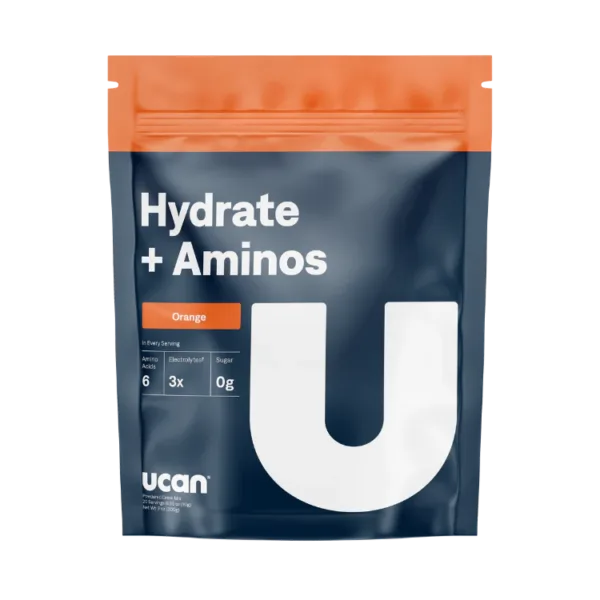
UCAN Hydrate
3 serves
300mg sodium each
Mix 3 serves across 950ml of water and sip every 10 minutes rather than drinking large volumes at once.
A starting point, not a prescription. Sweat rate and sweat concentration vary a lot between people and change with heat, humidity and altitude. Adjust from here based on how you feel across a few sessions. If you are already using UCAN Edge + Electrolyte gels, each one adds 200mg of sodium, so count those in.
The fluid that goes with the sodium
Sodium and water work together, and getting the sodium right while under-drinking is a common way to feel worse rather than better. If you are behind on fluid, fix the fluid first and the sodium second.
The working range is 400 to 550ml per hour for most endurance sessions, again with the upper end for heavy sweaters and hot conditions. Sip every 10 minutes to build a rhythm. Smaller, more frequent mouthfuls are easier on the gut than draining half a bottle at an aid station, which is a habit almost every endurance athlete has to unlearn.
Mixed as directed, one serve of electrolyte powder into 500ml puts you at 600 to 660mg of sodium per litre of finished drink. That is a useful way to compare products, because serve sizes and mixing volumes vary enormously between brands and the per serve figure on its own tells you very little.
One serve into 500ml. 600mg of sodium per litre of finished drink, which is where the comparison between brands should happen.
Sodium in the bottle, or sodium in the gel
Once you have your hourly number, the only remaining question is how it gets into you. That decision usually comes down to whether you want to carry a bottle.
Delivery
Sodium
You still need to carry
Suits you if
Electrolyte powder in a bottle
300 to 330mg per serve
A bottle, plus your fuel separately
You want to dose sodium and carbohydrate independently
Gels with electrolytes
around 200mg per gel
Water only, from taps or aid stations
You would rather not carry a bottle at all
Salt capsules
Varies widely, check the label
Water, and something to swallow them with
You can swallow capsules while running hard
A common setup is to combine them. Powder in the bottle for a steady baseline, gels with electrolytes for the top-up, and the two numbers added together to hit the hourly target. If you go that way, count the gel sodium in rather than treating it as a bonus.
Adjusting from the starting point
The number the calculator gives you is a hypothesis, not a plan. What turns it into a plan is a few weeks of using it and paying attention.
Sweat tests and pre and post weigh-ins are useful, but they describe the conditions you tested in rather than the conditions you will race in. Athletes who rely on the numbers alone tend to get caught out on the first genuinely hot day. Use the figures as a starting band, then let how you feel across a training block move you up or down within it.
If you have gone weeks of long sessions without any of the sloshing, headaches or flatness that usually signal you have the balance wrong, you are probably in a good place. If something feels consistently off, revisit fluid before sodium, because under-drinking is by far the more common problem. Anything persistent is worth raising with a sports dietitian rather than solving from a blog.
"Awesome for hydration during 1-1.5 hour runs. Have been great for my marathon training."
Michael A. · verified buyer on ucan.co · Berry Hydrate
Published guidance for endurance work sits at 300 to 600mg of sodium per hour, paired with 400 to 550ml of fluid, for sessions past 55 minutes. Start in the middle of that band, take the lower end if you sweat lightly in cool conditions and the upper end if you finish drenched with salt marks on your kit.
Do I really need 1,000mg of sodium per hour?
Most people do not. That figure comes from products aimed at athletes with genuinely high sweat rates and salty sweat, which is a real group but a much smaller one than the marketing suggests. Choosing the product with the highest number on the packet is not the same as choosing the right one, and more sodium without enough fluid alongside it does not help.
How do I calculate my sweat rate?
Weigh yourself undressed before a one hour session, note every millilitre you drink, then weigh yourself again after towelling off. Weight lost in kilograms plus fluid drunk in litres equals your sweat loss for that hour, because one kilogram of body weight is one litre of fluid. Repeat it once in the heat, since your rate can differ by a factor of two between conditions.
How much sodium is in a litre of sweat?
Roughly 200 to 2,000mg per litre, and it is largely genetic rather than trainable. You cannot easily measure it at home, but visible white salt marks on your kit after a session are a reasonable sign you are towards the higher end.
Do I need electrolytes for a session under an hour?
Usually not. Water is generally enough for a short session in mild conditions. The case for replacing sodium starts to build past about 55 minutes, and it builds faster in heat and humidity or if you know you sweat heavily.
Should I count the sodium in my gels?
Yes. A gel with added electrolytes typically carries around 200mg of sodium. If you take one every 45 minutes alongside a bottle, that is a meaningful contribution to your hourly total and should be counted in rather than treated as extra.
How do I compare sodium between brands fairly?
Convert both to per litre of finished drink. Take the sodium per serve and scale it to the mixing volume the maker recommends. A 300mg serve into 500ml is 600mg per litre. A 1,000mg serve into a litre is 1,000mg per litre. Serve sizes and mixing volumes vary enormously, so the per serve figure alone tells you very little.
Ranges quoted are drawn from published sports nutrition guidance and are typical rather than prescriptive. Sweat rate and sweat concentration vary widely between individuals. Guidance here is general and not individual advice. If something feels persistently wrong with your hydration, speak to a sports dietitian or your doctor rather than adjusting from an article.
Sports Dietitian Bob Seebohar was the personal sports dietitian for the 2008 U.S. Olympic Triathlon team and takes a cutting-edge approach to nutrition with his Metabolic Efficiency
The combination of white, pink blast, total orange and bright crimson will mark Nike's presence in Tokyo across select performance and lifestyle products.
We’re all familiar with the afternoon slump. You’re going about your day, feeling fine, but then 2 p.m. hits—and instead of thinking about a pre-dinner workout, you’re suddenly thinking about a pre-dinner nap.
Best Caffeine Gel for Endurance: How Caffeine Fuels Performance For most endurance athletes, caffeine is part of the ritual. A coffee before a morning run,...
by Sarah UCAN AUS Team1531Comments Off on Best Caffeine Gel for Endurance: How Caffeine Fuels Performance




 by Sarah UCAN AUS Team
170
Comments Off on How Sara Hall Takes Her Training to the Next Level with UCAN
by Sarah UCAN AUS Team
170
Comments Off on How Sara Hall Takes Her Training to the Next Level with UCAN 

Comments are closed