Hydration for Marathon Training: The Australian Runner's Sodium and Fluid Plan
Most runners already drink enough. What they get wrong is sodium per hour, and they only find out at 32 km when the legs go heavy and the stomach stops accepting anything.
Hydration for marathon training is not a race day decision. It is a number you work out in training, then repeat. This guide gives you the sweat rate test, the hourly sodium target, how to count what is already in your gels, and a race day plan you can rehearse on a long run. It covers the fluid and mineral side only. The carbohydrate side sits in the marathon fuel plan.
The short version
Work out your sweat rate over one long run. Aim for roughly 300 to 600 mg of sodium per hour. Count the sodium already coming from your gels. Replace 60 to 80 percent of what you lose, not 100 percent. Practise it before race day, never on race day.
The problem is not water, it is sodium per hour
Sweat is not water. It carries sodium, chloride, potassium, magnesium and calcium out with it, in roughly that order of quantity. Drink plain water for three hours and you replace the fluid while the mineral concentration in your blood keeps falling.
Two numbers vary enormously between runners, which is why generic advice fails. Sweat rate in marathon runners commonly sits between 0.8 and 1.5 litres per hour, and climbs above two litres on a humid Australian summer morning. Sweat sodium concentration is quoted anywhere from about 400 to 1,800 mg per litre. Two runners side by side at the same pace can be losing three times different amounts of salt.
So the useful question is not "am I drinking enough". It is how much sodium am I taking in per hour, and does it match what I am losing. That is a number, and you can measure it in one session. If you want the background on what each mineral does before you go further, start with the ultimate guide to electrolyte drinks and come back.
Find your sweat rate in one long run
This takes one long run and a set of bathroom scales. Do it twice, once in cool conditions and once in the heat, because the two answers will be different and you need both.
Step
What to do
1
Weigh yourself in minimal clothing, after the toilet, immediately before you head out. Note the weight in kilograms.
2
Run 60 to 90 minutes at your usual long run effort. Record exactly how many millilitres you drink.
3
Towel off, strip the wet kit and weigh yourself again straight away.
4
Every kilogram lost is roughly one litre of sweat. Add back whatever you drank, then divide by the hours you ran.
Worked example. You start at 72.0 kg and finish at 70.9 kg after 90 minutes, having drunk 500 ml.
Weight lost: 1.1 kg, so 1,100 ml of sweat
Plus fluid drunk: 1,100 + 500 = 1,600 ml total sweat loss
Over 1.5 hours: 1,067 ml per hour
Now you have your number. Repeat it in February at 6 am and you will likely find it has jumped by 40 to 60 percent. That second number is the one that matters for summer training and for a warm race.
Two checks worth adding. If you finish a long run with white salt marks on your cap, your temples or your black kit, you sit at the higher end of the sweat sodium range. And if you finish heavier than you started, you are drinking more than you are losing, which is a genuine risk over marathon distance and the one case where the fix is to drink less, not more.
How much sodium per hour
The internet argues about 1,000 mg an hour. Most published guidance for endurance events lands lower, in the range of 300 to 600 mg of sodium per hour, with the top end reserved for heavy and salty sweaters in heat. Start in the middle, then adjust across a few sessions based on how you actually feel at hour three.
Session
Fluid per hour
Sodium per hour
Easy run under 60 minutes, cool
Water is fine
Nothing needed
Long run 90 min to 2 h, cool morning
400 to 600 ml
300 to 400 mg
Long run in summer heat and humidity
600 to 900 ml
500 to 600 mg
Marathon race, cool conditions
400 to 700 ml
400 to 500 mg
Marathon or long course race, warm
600 to 800 ml
500 to 600 mg
One rule underneath all of it: aim to replace roughly 60 to 80 percent of your sweat loss, not all of it. Finishing a marathon one to two percent lighter than you started is normal and well tolerated. Chasing 100 percent replacement puts a volume of fluid through your stomach that it does not want at race pace.
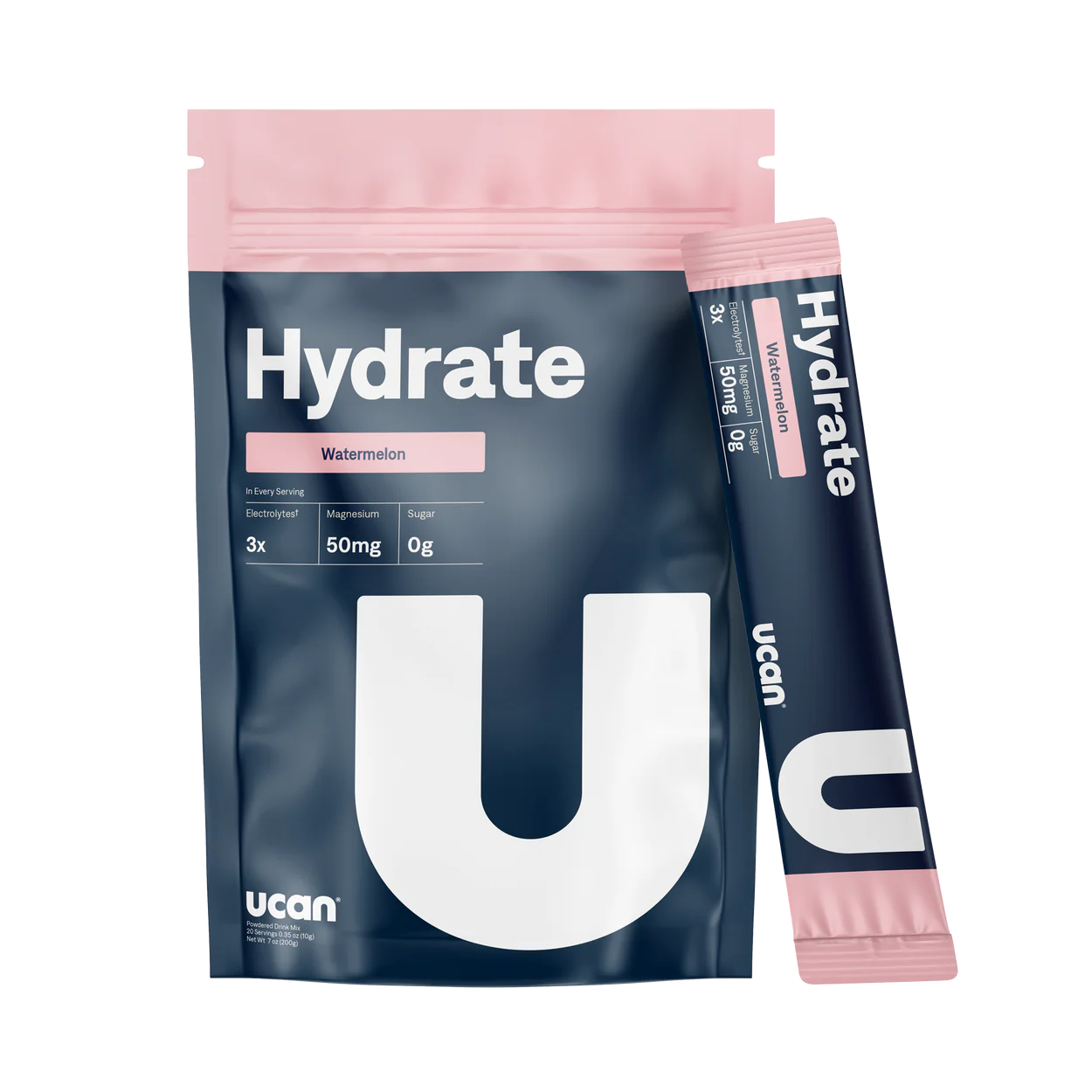
A single 3 g serve of sugar free electrolyte drinks in 500 ml of water puts 300 to 330 mg of sodium in the bottle, along with 100 mg potassium, 50 mg magnesium, 150 mg chloride and 20 mg calcium. Two serves across a litre gets you to 600 to 660 mg per litre. Zero sugar, zero kilojoules, and nothing that changes your carbohydrate plan.
Pineapple carries the most sodium in the Hydrate range at 330 mg per serve.
Count the sodium already in your gels
This is the step almost everyone skips, and it is why some runners end up doubling their sodium without meaning to while others fall short. Your fuel carries salt. Add it to the total before you decide what goes in the bottle. The figures below are for the UCAN Edge energy gels range, read off the current Australian pack labels.
Product
Sodium per serve
Also carries
UCAN Hydrate, one 3 g serve in 500 ml
300 to 330 mg
Potassium, magnesium, chloride, calcium. No carbohydrate.
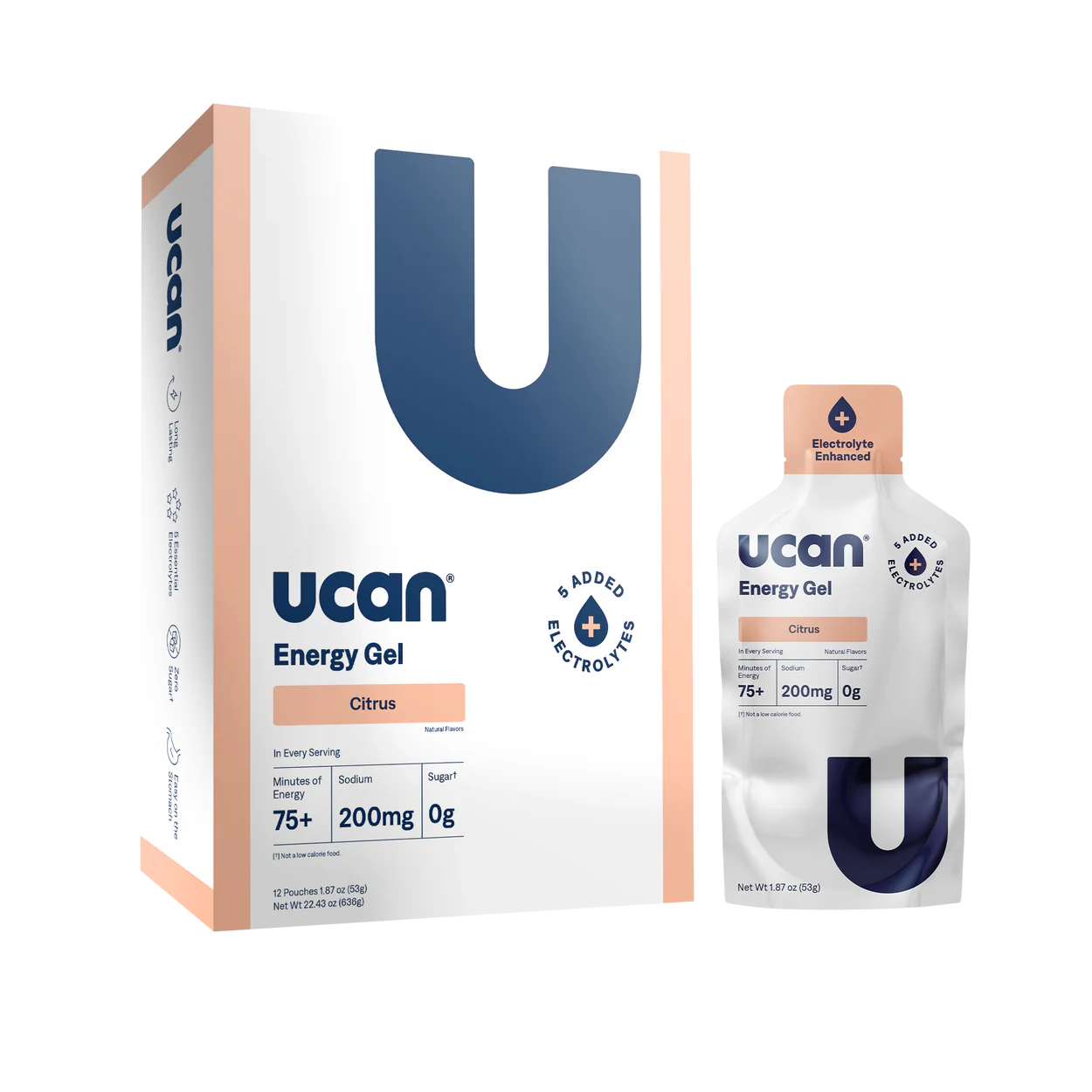
UCAN Edge + Electrolyte gel
200 mg
20 g carbohydrate, plus potassium, chloride, magnesium, calcium
UCAN Edge gel, original
50 mg
19 g carbohydrate
UCAN Edge Mixed Berry with caffeine
30 mg
45 mg caffeine. This one is not an electrolyte gel.
That last row catches people out. If you are running on the caffeine gel, your fuel is contributing almost no sodium, so the bottle has to carry the whole load. There is more on dosing in the guide to choosing a caffeine gel for endurance.
Two ways to reach the same target.
Cool morning long run, sodium in the bottle
One Hydrate serve per hour (300 mg) plus one original Edge gel per hour (50 mg) = 350 mg per hour
Hot summer long run, sodium split between bottle and fuel
One Hydrate Pineapple serve per hour (330 mg) plus one Edge + Electrolyte gel per hour (200 mg) = 530 mg per hour
Pineapple is the highest sodium flavour in the Hydrate range at 330 mg, which is the one to reach for on the hottest days. Everything else in the formula is identical across the four flavours, so the rest of the choice is taste. If you are still deciding what goes in your race belt, the comparison of sugar based and sugar free energy gels covers the trade-offs, and there is a wider round-up of the best energy gels for marathon running in Australian conditions.
Hydration through a marathon block
A marathon build is 12 to 18 weeks. Your hydration plan is not the same in week two as it is in week fourteen, and the point of the block is to arrive at race day with nothing left to guess.
Phase
The hydration job
Weeks 1 to 4 Base
Run the sweat rate test twice, once cool and once warm. Get your daily intake consistent rather than clustered around runs. Do not carry anything on runs under an hour.
Weeks 5 to 10 Build
Long runs pass two hours. Start drinking to a schedule instead of to thirst. Trial your electrolyte flavour for a full three hours, because the flavour you like at minute ten is not always the one you can still drink at minute one hundred and eighty. Buy a single sachet before you commit to a jar.
Weeks 11 to 14 Peak
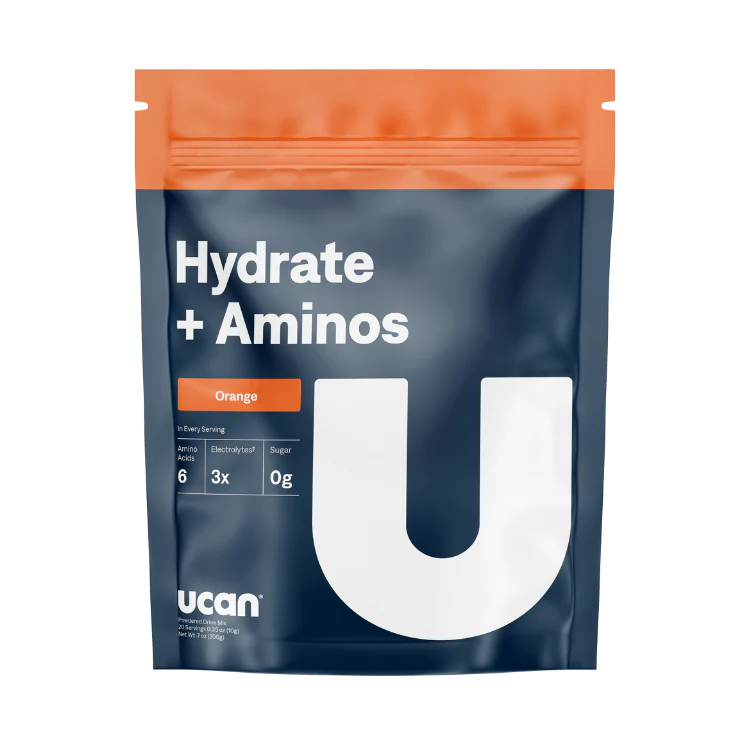
Rehearse race day exactly. Same bottle, same concentration, same timing, at race pace. If you are running doubles or back to back long sessions, this is where Hydrate + Aminos earns its place, with six amino acids on top of the same electrolyte base.
Weeks 15 to 16 Taper
Change nothing. Volume drops, so your total fluid need drops with it. Do not start a new product, a new flavour or a new sodium target in taper.
Testing a flavour for three hours is cheap if you do it properly. Every Hydrate flavour is available as a single sachet, which removes the risk of buying a 30 serve jar of something you cannot finish.
One thing that sits alongside hydration in the build and gets ignored: your pre session drink. If you take a base of UCAN Energy Powder 30 minutes before a long run, three of the four flavours also carry 130 to 170 mg of sodium, which counts toward your first hour. The Unflavoured version carries none, so if that is your base, the bottle does all the work.
Training through an Australian summer
If you are building for an Australian spring marathon, the bulk of your long runs land in warm months. Northern hemisphere plans assume you build in autumn and race in the cold. Ours does the opposite, and every hydration number in a US or UK training plan is written for the wrong season.
Heat adaptation takes roughly 10 to 14 days of consistent exposure. If your race is warm, the last thing you want is to do every long run at 5 am in the only cool hour of the day and then meet 24 degrees on race morning having never run in it. Move one session a week into the warmer part of the day during the build, at reduced pace, and keep it there.
Practical things that matter in Australian conditions:
Humidity is the variable that catches people out, not temperature. Sweat that drips instead of evaporating is fluid lost with no cooling benefit. Brisbane, Cairns and Darwin runners need a higher fluid target than a Melbourne runner at the same air temperature.
A 5 am start does not remove the need for electrolytes. Humidity is often at its highest just after dawn.
Freeze half your bottle the night before and top it with water in the morning. You will drink more when it stays cold, and cold fluid empties from the stomach at least as fast as warm.
Plan a refill point on any run over 90 minutes rather than carrying two litres. Sticks travel better than a jar and a scoop for that job.
Give yourself longer to warm up in the cool months and less in the heat. The warming up before running guide covers how to adjust it by season.
The same principles apply across distances, and if you are training for something other than a road marathon there are session specific versions for running and for triathlon, where the bike leg changes what you can carry and how much you can drink.
Race week and race day
Race week hydration is unremarkable by design. Drink consistently across each day rather than forcing large volumes on Friday and Saturday. Extra sodium in your food across the final two days is more useful than extra water. Check your urine colour in the morning, aim for pale straw, and then stop thinking about it.
The morning of. 500 to 600 ml with an electrolyte serve, two to three hours before the gun. A further 150 to 250 ml about 20 minutes before the start, then stop. Anything later has nowhere to go except your bladder in the first 5 km.
Point in the race
Fluid
Fuel and sodium
0 to 10 km
150 to 200 ml at each station, even though you do not feel you need it
First gel around 45 to 60 minutes, before you feel the dip
10 to 21 km
Hold the same rhythm. This is where the plan is won.
Second gel. Keep sodium arriving every hour, not in one hit.
21 to 32 km
Do not increase volume to compensate for feeling flat. Stay on the schedule.
Third gel. If it is warm, this is where the electrolyte version does the most work.
32 km to finish
Small mouthfuls only. Large volumes late sit in the stomach.
Fourth gel if you are still taking them. Nothing new, nothing untested.
The single most common race day error is not under-drinking. It is taking whatever is handed out at the aid station, at a concentration and a sugar load you have never trained on, in the last third of a race. Carry your own if the course allows it. The reason this works with LIVSTEADY is that the carbohydrate and the electrolytes are separate decisions, so changing one does not force you to recalculate the other.
After you finish
Weigh yourself when you get home if you want the honest number. The general guide is to take in around 1.2 to 1.5 litres of fluid for every kilogram lost, spread across the following four to six hours rather than drunk in one go. Fluid with sodium in it is retained better than plain water, which is the whole reason an electrolyte serve is worth more than a bottle of tap water at this point.
If you have another session inside 24 hours, which is the normal case mid-block rather than after a goal race, Hydrate + Aminos adds six amino acids including glutamine to the same electrolyte base. Protein sits alongside it rather than instead of it, and the timing question is covered in when to take protein shakes.
What to put in the bottle
Three formats, one formula. The choice is where you will be drinking it.
How much water should I drink during marathon training?
There is no single figure, which is why the sweat rate test matters. Most runners lose between 0.8 and 1.5 litres per hour, and more in Australian summer humidity. Aim to replace 60 to 80 percent of that during the run, which usually lands between 400 and 800 ml per hour. Finishing one to two percent lighter than you started is normal.
How much sodium do marathon runners need per hour?
Most guidance sits between 300 and 600 mg of sodium per hour, with the upper end for heavy or salty sweaters racing in heat. Start at 400 mg and adjust across a few long runs. Count the sodium in your gels as part of that total, not on top of it.
Do I need electrolytes on an easy 45 minute run?
In cool conditions, no. Water is enough for anything under an hour at easy effort. In summer heat and humidity a 45 minute session can still move a litre of sweat, so it becomes worth having sodium in the bottle. Judge it on conditions and sweat loss, not on duration alone.
Can I use an electrolyte drink and energy gels at the same time?
Yes, and it is the cleanest way to run the two systems separately. UCAN Hydrate carries no carbohydrate at all, so adding it changes nothing about your fuelling maths. Add the sodium from your gels to the sodium in your bottle to get your hourly total.
Which UCAN Hydrate flavour has the most sodium?
Pineapple, at 330 mg per serve. Watermelon and Berry sit at 310 mg and Lemon Lime at 300 mg. Everything else in the formula is identical across all four, so choose on taste and reach for Pineapple on the hottest days.
Is it possible to drink too much during a marathon?
Yes. Drinking more than you sweat over several hours is a recognised risk in marathon running, and it is more likely in slower finishers who stop at every station. The safeguard is simple: know your sweat rate, drink to a schedule that sits below it, and do not finish the race heavier than you started.
Jar or sticks for marathon training?
Identical formula and identical 3 g serve, flavour for flavour. The jar works out around a third of the price per serve and lives at home for daily use and pre run bottles. The sticks travel, fit a race belt and dose accurately without a scoop. Most runners in a marathon block end up with both.
These figures are a starting point, not a prescription. Sweat rate and sweat sodium concentration vary widely between individuals and change with heat, humidity and fitness. Adjust from here based on your own testing across several sessions.
Walk into any servo, supermarket or sports store in Australia and you will see two categories sitting next to each other: sports drinks and electrolyte...
Recovery Nutrition Tips for Runners Recovery nutrition for runners is key to replenishing and refueling to ensure that you have energy stores available to use...
FUELING YOUR PERSONAL BEST American Half Marathon Record Holder Emily Sisson relies on UCAN for long-lasting energy with no crash. SUSTAINED ENERGY WITHOUT GI DISTRESS...






 28Oct
28Oct  by
by 




Comments are closed