📦 Energy Gel EDGE Watermelon + Caffeine back in stock | 🇦🇺 Free shipping in Australia over 220 AUD
$0.00
0
Sugar free, no added sugar and unsweetened are three different claims
Sugar free electrolytes are everywhere in the Australian hydration aisle, and the phrase does not always mean what you assume. Some products earn it. Some are making a different claim in the same words. And a few that say it on the front are carrying more carbohydrate than a mouthful of sports drink.
The words on the pack are governed by law here, but the law is more specific than most people realise. Sugar free, no added sugar and unsweetened each have their own test under the Australia New Zealand Food Standards Code. A product can pass one and fail the other two.
This is a guide to reading the label rather than the marketing. What each claim legally requires, where sugar hides in an electrolyte powder, why the per 100g column will frighten you if you do not know how to use it, and the two lines that actually tell you what is going in your bottle.
The short version
In Australia, low sugar means no more than 5g per 100g of powder, and a sugar free claim is anchored to that same threshold. No added sugar is a different test and still allows up to 10g per 100g. Unsweetened is stricter again and rules out stevia entirely. None of the three tells you how much energy is in the tin. Read two lines on the nutrition information panel instead: energy per serve, and sugars per serve.
What sugar free electrolytes actually means in Australia
Sugar free electrolytes are electrolyte drinks or powders that replace the sodium, chloride, potassium, magnesium and calcium you lose in sweat without adding sugar to do it. In Australia the claim is regulated: to say sugar free on the pack, a product has to meet the low sugar conditions in Schedule 4 of the Food Standards Code, which is no more than 5g of sugars per 100g for a powder or 2.5g per 100mL for a ready to drink liquid.
That is the legal floor. What it does not tell you is how much energy is in the product, what sweetens it, or how much sodium you are actually getting. Those are three separate questions and each has its own line on the panel.
Sugar free, no added sugar and unsweetened are three different claims
Nutrition content claims sit under Standard 1.2.7 of the Code, administered by Food Standards Australia New Zealand. Four terms turn up constantly on electrolyte packaging, and they form a hierarchy from loosest to strictest.
Claim
What it requires
Sugar still allowed?
No added sugar
No added sugars, honey, malt or malt extracts, and no added concentrated or deionised fruit juice. Since 2023, total sugars must also stay under 10g per 100g for a solid or 7.5g per 100mL for a liquid.
Yes, up to 10g per 100g
Low sugar
No more than 2.5g of sugars per 100mL for a liquid, or 5g per 100g for a solid. An electrolyte powder is assessed as a solid.
Yes, up to 5g per 100g
Sugar free
Anchored to the low sugar conditions above. In practice, most products marketed as sugar free electrolytes declare 0g of sugars per serve.
In theory yes, in practice almost never
Unsweetened
Has to meet the no added sugar conditions and contain no intense sweeteners at all, including stevia, sucralose, aspartame and the sugar alcohols.
No sweetener of any kind
No added sugar does not mean electrolytes without sugar. A product can carry 9g of sugars per 100g, add none of it deliberately, and make the claim honestly. Naturally occurring sugars count towards what you drink but not against the claim.
Unsweetened is a much higher bar than most people assume. A stevia sweetened electrolyte powder is not unsweetened and cannot be sold as such in Australia, however natural the sweetener is. If you are searching for unsweetened electrolytes, what you actually want is a genuinely unflavoured mineral blend, which is a small and separate corner of the market.
Why the per 100g column on an electrolyte powder looks alarming
This is the most common misreading, and it catches people who are otherwise good at labels.
An Australian nutrition information panel has two columns: per serving, and per 100g. On a jar of electrolyte powder a serve is typically 3 to 10 grams. Nobody eats 100g of it. The per 100g column exists so you can compare two products with different serve sizes against each other, and for nothing else.
What people read
10,000mg sodium
Per 100g. Looks like you are about to drink ten grams of salt.
What you actually get
300mg sodium
Per 3g serve, in 500ml of water. A normal amount for an hour of endurance work.
One more layer. A powder is regulated as a solid, so the 5g per 100g threshold applies to what sits in the tin. But you drink it diluted, usually one serve into 500ml. A powder sitting right on the legal threshold delivers a trivial amount of sugar once it is in the bottle. The claim is measured on the powder. Your gut meets the drink.
Where sugar hides in electrolytes without sugar on the front
Sugars have to appear on the panel. Carbohydrate that is not a sugar does not, beyond the total carbohydrate line. That gap is where most of the confusion lives, and it is how a product can be both technically sugar free and quietly full of fuel.
Ingredient
On the sugars line?
What you need to know
Maltodextrin
No
A carbohydrate, not a sugar. Still roughly 17 kilojoules per gram, still fuel. Common where a brand wants a sugar free claim and a carbohydrate load in the same tin.
Dextrose, glucose
Yes
Oral rehydration formulas use them deliberately, to help the body take up sodium and water together. There is a reason for them, but they rule out a sugar free claim.
Fruit juice powder
Yes
Adds flavour, colour and sugars. Blocks a no added sugar claim if it is concentrated or deionised.
Sugar alcohols
No
Xylitol, sorbitol, maltitol, erythritol. Carry energy, and some athletes find them hard on the stomach mid session. Their presence also rules out an unsweetened claim.
Added protein or aminos
No
Carry roughly 17 kilojoules per gram. A hydration product with aminos added can be genuinely sugar free and still show energy on the panel.
The shortcut: if the sugars line reads 0g but the carbohydrate line does not, something in the tin is carbohydrate that is not a sugar. Not necessarily a problem, but it is fuel, and you should count it if you are also taking gels.
Sugar free electrolytes are not always calorie free
A product can be legitimately sugar free and still carry energy. Maltodextrin, sugar alcohols, added protein and amino acids all contribute kilojoules without touching the sugars line.
If what you want is a bottle that adds nothing to your fuelling plan, the number to check is the energy line, not the claim on the front. Zero sugars and zero kilojoules together mean the electrolytes are mineral salts and the sweetness comes from an intense sweetener. Mineral salts carry no energy at all, which is why a genuinely zero calorie electrolyte drink is possible in the first place.
What replaces the sugar in a sugar free electrolyte drink
Something has to make it drinkable, because a solution of mineral salts on its own tastes like seawater. Four options turn up on Australian shelves.
Steviol glycosides, listed as stevia extract or Rebaudioside A. Plant derived, no energy, and the usual choice for brands positioning away from artificial ingredients.
Sucralose, additive 955. Synthetic, no energy, widely used and stable in liquid.
Acesulfame potassium, additive 950. Synthetic, usually blended with sucralose to smooth the aftertaste.
Sugar alcohols, such as erythritol and xylitol. Bulk sweeteners rather than intense ones, so they sit much higher up the ingredient list and they do carry energy.
All four are approved for use in Australia. The choice is a preference, not a safety question. What matters practically is that if you are drinking the same flavour several times a week for months, an aftertaste you dislike is the thing that will make you stop.
Stevia sweetened, zero sugars, zero kilojoules. Sugar free and calorie free in the same product, which is not always the case.
Reading a sugar free electrolyte powder label, line by line
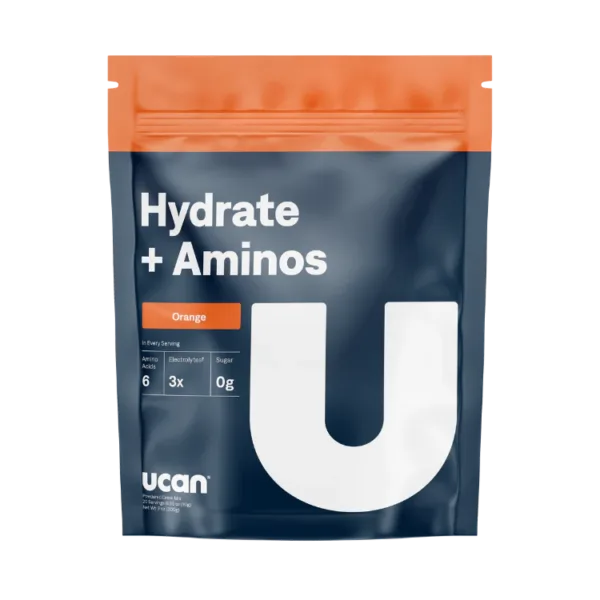
Here is a real panel, from UCAN Hydrate Berry, with what each line is actually telling you.
Line
Per 3g serve
What it tells you
Energy
0kJ
Nothing in the bottle is fuel. Read this before you read the sugar claim.
Carbohydrate
0g
If this sat above zero while sugars read zero, there would be maltodextrin or similar in the tin.
Sugars
0g
The line the sugar free claim rests on.
Sodium
310mg
The one doing the work. Compare it per litre of finished drink, not per serve.
Chloride
150mg
The second most abundant electrolyte in sweat, and the one most often left off a panel entirely.
Potassium
100mg
Lost in far smaller quantities than sodium, so the figure is smaller by design.
Magnesium
50mg
Only appears when the maker has chosen to declare it. Its absence usually means zero.
Calcium
20mg
The smallest of the five, and the one most electrolyte powders leave out.
Ingredients
—
Listed by weight, largest first. Whatever sweetens it appears here, and where it sits tells you how much there is.
The five kinds of electrolyte product, and where the sugar sits
Not every electrolyte product is trying to be sugar free, and some of them have good reasons not to be. Knowing which category you are holding explains most of what is on the panel.
Type
Sugar per serve
Energy per serve
What it is for
Sugar free electrolyte powder
0g
0kJ
Fluid and minerals only, when your carbohydrate is coming from somewhere else
Carbohydrate sports drink
25 to 30g per 500ml
400 to 500kJ
Fluid and fuel in one bottle, when the drink is your only fuel source
Oral rehydration salts
3 to 6g
60 to 110kJ
Glucose is there on purpose, to help sodium and water move together
Electrolyte tablets
0 to 1g
0 to 40kJ
Portability. Usually lower sodium than a powder, so check the figure
Salt capsules
0g
0kJ
Sodium without flavour or fluid. You still have to drink the water separately
Figures are typical of each category rather than of any single brand. If you are trying to work out which one belongs in your bottle, the deciding question is usually where your carbohydrate is coming from. Our comparison of sugar based and sugar free fuelling covers that side of it.
A five second check in the aisle
Energy per serve. Zero means the bottle adds nothing to your fuelling. Anything above zero is carbohydrate, protein or a sugar alcohol.
Sugars per serve. Should read 0g if the front says sugar free.
Carbohydrate per serve. If it sits above the sugars figure, find out what the difference is.
Sodium per serve, then per litre. Scale it to the mixing volume. A serve into 500ml doubles the per serve figure to give the concentration.
The sweetener, in the ingredient list. Near the end means an intense sweetener. Near the start means a bulk one, which carries energy.
"Love the taste. Love that it's zero sugar. Never train without it. This is an excellent product."
Hossein F. · verified buyer on ucan.co · Lemon Lime Hydrate
Are sugar free electrolytes as effective as ones with sugar?
For replacing what you lose in sweat, the sugar is not doing that job. The minerals are. Sugar earns its place when the drink is also meant to be your fuel, or in an oral rehydration formula where glucose is included deliberately to help sodium and water uptake. If your carbohydrate is already coming from gels or a powder, sugar free electrolytes do the hydration job without adding fuel you did not plan.
Does sugar free mean there are no calories?
No. Maltodextrin, sugar alcohols, protein and amino acids all carry energy without appearing on the sugars line. Check the energy figure in the per serving column. Zero sugars and zero kilojoules together is the combination that means nothing in the bottle is fuel.
Is stevia allowed in a sugar free electrolyte drink?
Yes. Steviol glycosides are approved in Australia and carry no energy, so a stevia sweetened product can be sugar free. What it cannot be is unsweetened. That claim requires no intense sweeteners at all, stevia included.
What is the difference between sugar free and no added sugar?
No added sugar is about what went in during manufacture, and since 2023 total sugars also have to stay under 10g per 100g for a solid or 7.5g per 100mL for a liquid. A sugar free claim is anchored to the low sugar conditions instead, which is no more than 5g per 100g for a powder. Different tests, and a product can pass one without passing the other.
Why does the label say 10,000mg of sodium per 100g?
Because the per 100g column exists to let you compare products, not to describe a serve. Nobody drinks 100g of electrolyte powder. At a 3g serve, 10,000mg per 100g works out to 300mg, a normal hourly amount for endurance work. Always read the per serving column first.
How do I compare two sugar free electrolyte powders fairly?
Convert both to per litre of finished drink. Take the sodium per serve, then scale it to the mixing volume the maker recommends. A 300mg serve into 500ml is 600mg per litre. A 1,000mg serve into a litre is 1,000mg per litre. Serve sizes and mixing volumes vary enormously between brands, so the per serve figure on its own tells you very little.
Are there unsweetened electrolytes in Australia?
Yes, but fewer than you would think, because the claim is strict. Unsweetened requires no intense sweeteners and no sugar alcohols, which rules out most flavoured powders including stevia sweetened ones. What you are usually looking for is an unflavoured mineral blend rather than a flavoured product with the sweetener removed.
Which electrolytes should a sugar free powder actually contain?
Sodium first, because it is the one you lose most of in sweat and the one that helps you hold onto the fluid you drink. Chloride comes second by quantity. Potassium, magnesium and calcium are lost in far smaller amounts, so the figures on a panel are smaller by design rather than by omission. A product declaring all five is being more transparent than one declaring two.
Claim conditions are drawn from Standard 1.2.7 and Schedule 4 of the Australia New Zealand Food Standards Code, correct as at September 2026. Category figures are typical of each product type rather than of any single brand. Product figures are taken from the nutrition information panels of the products named. Guidance here is general and not individual advice. Test any change to your fuelling in training before you race it.
Sports Dietitian Bob Seebohar was the personal sports dietitian for the 2008 U.S. Olympic Triathlon team and takes a cutting-edge approach to nutrition with his Metabolic Efficiency
The combination of white, pink blast, total orange and bright crimson will mark Nike's presence in Tokyo across select performance and lifestyle products.
We’re all familiar with the afternoon slump. You’re going about your day, feeling fine, but then 2 p.m. hits—and instead of thinking about a pre-dinner workout, you’re suddenly thinking about a pre-dinner nap.
Best Caffeine Gel for Endurance: How Caffeine Fuels Performance For most endurance athletes, caffeine is part of the ritual. A coffee before a morning run,...
by Sarah UCAN AUS Team1535Comments Off on Best Caffeine Gel for Endurance: How Caffeine Fuels Performance





 by Sarah UCAN AUS Team
170
Comments Off on How Sara Hall Takes Her Training to the Next Level with UCAN
by Sarah UCAN AUS Team
170
Comments Off on How Sara Hall Takes Her Training to the Next Level with UCAN 

Comments are closed